Tell us about the job
Takes about a minute. No obligation.
A contractor quoting a repair in Liberty County has to work out what actually wore the system down. 38 severe weather events were recorded in Liberty County, Texas between 2015 and 2024. At roughly that rate, severe weather is something a system here encounters periodically, and a compressor or capacitor that gives out is more likely carrying years of deferred maintenance or original installation quality than it is carrying storm load. The parts a contractor inspects first are the ones that age quietly: capacitors, contactors, refrigerant charge, and coil condition. That is where the bill usually comes from.
Ductwork that has been running since the mid-nineties has a history that shows up once the panels come off: compressor wear patterns, coil condition, the state of contactors and capacitors that have cycled through a lot of Texas summers. Half the homes in Liberty County, Texas were built in 1996 or earlier (2020-2024 ACS 5-year). That matters for repair work because the question a contractor has to answer is whether the parts a system of that age still accepts are in production and obtainable in a reasonable time, and that answer is not in the thermostat reading or the age stamped on the unit's nameplate. It lives in what the opened equipment actually contains.
The Parts of a Central AC a Contractor Checks First
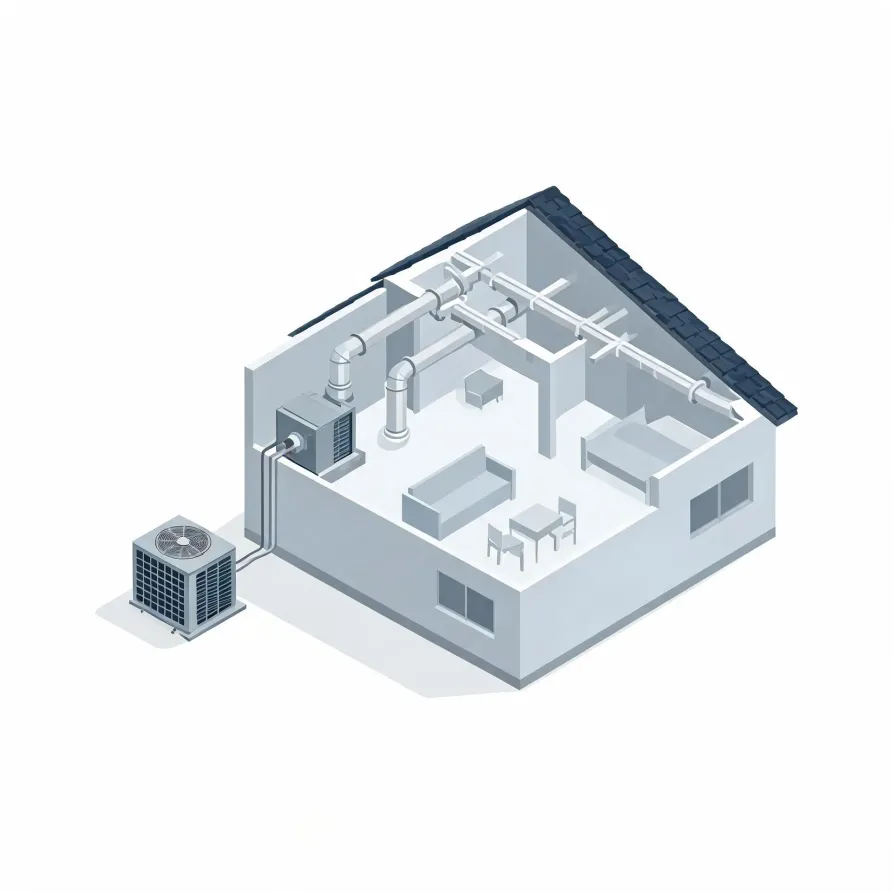
The outdoor condenser unit sits on a pad beside the house and holds the compressor and condenser coil. These are the pieces a contractor reaches first when a system stops cooling, runs but blows warm air, or makes noise it did not make before. The compressor is the part that does the hardest mechanical work, and the condenser coil is where heat moves out of the refrigerant.
Inside the house, the air handler holds the evaporator coil and the blower. The evaporator coil is a common source of trouble when airflow drops or ice forms on the unit. The blower motor and the expansion valve, which sits at the coil inlet and controls refrigerant flow, round out the pieces a contractor will move through during a repair call.
The drawing shows a typical layout, and a licensed contractor determines which components apply to your specific system and home.
Get matched in Liberty CountyLiberty County, Texas, by the numbers
38 severe weather events were recorded in Liberty County, Texas between 2015 and 2024.
NOAA National Centers for Environmental Information, Storm Events Database, bulk CSV export, events 2015-01-01 through 2024-12-31.Half the homes in Liberty County, Texas were built in 1996 or earlier (2020-2024 ACS 5-year).
U.S. Census Bureau, 2020-2024 American Community Survey 5-Year EstimatesLiberty County, Texas holds 36,121 housing units (2020-2024 ACS 5-year).
U.S. Census Bureau, 2020-2024 American Community Survey 5-Year EstimatesOwners occupy 82.3% of the occupied homes in Liberty County, Texas (2020-2024 ACS 5-year).
U.S. Census Bureau, 2020-2024 American Community Survey 5-Year EstimatesCodes & Standards Behind Central AC Repair in Liberty County, Texas9 sourced rules and standards
What HVAC Repair Looks Like in Liberty County
Split-system central air conditioners rated below 45,000 Btu/h manufactured on or after January 1, 2023 must meet a federal minimum of 13.4 SEER2.
Split-system central air conditioners rated at or above 45,000 Btu/h manufactured on or after January 1, 2023 must meet a federal minimum of 13.4 SEER2.
Split-system central air conditioners manufactured between January 1, 2015 and December 31, 2022 had to meet 13 SEER, the metric that preceded SEER2.
Single-package central air conditioners manufactured on or after January 1, 2023 must meet a federal minimum of 13.4 SEER2.
Space-constrained central air conditioners manufactured on or after January 1, 2023 must meet a federal minimum of 11.7 SEER2.
Federal efficiency standards for split-system central air conditioners and heat pumps are set on each certified combination of outdoor unit and indoor coil rather than on the outdoor unit alone.
Residential and light commercial air conditioning and heat pump systems assembled in the field, including mini-splits and unitary systems, may not be installed on or after January 1, 2025 using a refrigerant with a global warming potential above 700.
A field-assembled system whose specified components were all manufactured or imported before January 1, 2025 carries no installation compliance date under the refrigerant restrictions and may still be installed.
Licensing and Legal Requirements in Liberty County, Texas
In Texas a person may not engage in air conditioning and refrigeration contracting unless that person holds a license issued under the state air conditioning and refrigeration contractor law.
Severe Weather Events in Liberty County
Storm activity puts stress on central AC systems, driving the kind of wear that turns into repair calls. How much of that load lands on equipment in Liberty County is a local question, and the data below records what conditions here have looked like.
38 severe weather events, 2015–2024. Source: NOAA National Centers for Environmental Information, Storm Events Database.