Tell us about the job
Takes about a minute. No obligation.

A contractor called out to diagnose a central AC failure in Colorado County has to weigh what the system has been through against what simply wore out. 32 severe weather events were recorded in Colorado County, Texas between 2015 and 2024. At that rate, severe weather is a real but infrequent variable in a system's life, not the standing condition that grinds components down year after year. What a contractor finds in a failed compressor or a leaking coil here points more often to deferred maintenance or the age of the unit than to storm load. The weather record belongs in the diagnosis, but it rarely closes it.
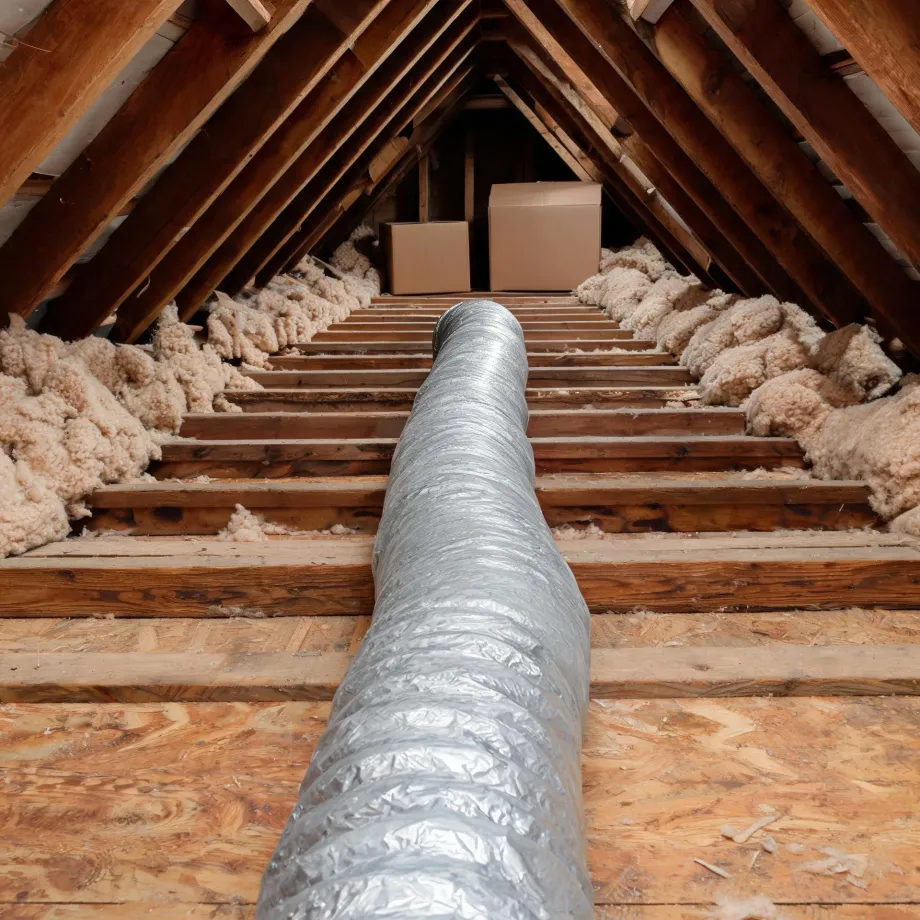
Half the homes in Colorado County, Texas were built in 1983 or earlier (2020-2024 ACS 5-year). When a central AC system fails in a house that old, what the opened unit contains decides how the job goes. Capacitors, contactors, and control boards on equipment that has cycled through decades of Texas summers wear in ways that are visible once the panels come off. The harder question is whether the parts that system takes are still in production. A contractor who finds a failed component on an older unit has to source it before the quote means anything, and on systems this vintage, that search sometimes ends with a recommendation to replace rather than repair.
The Parts of a Central AC a Contractor Checks First
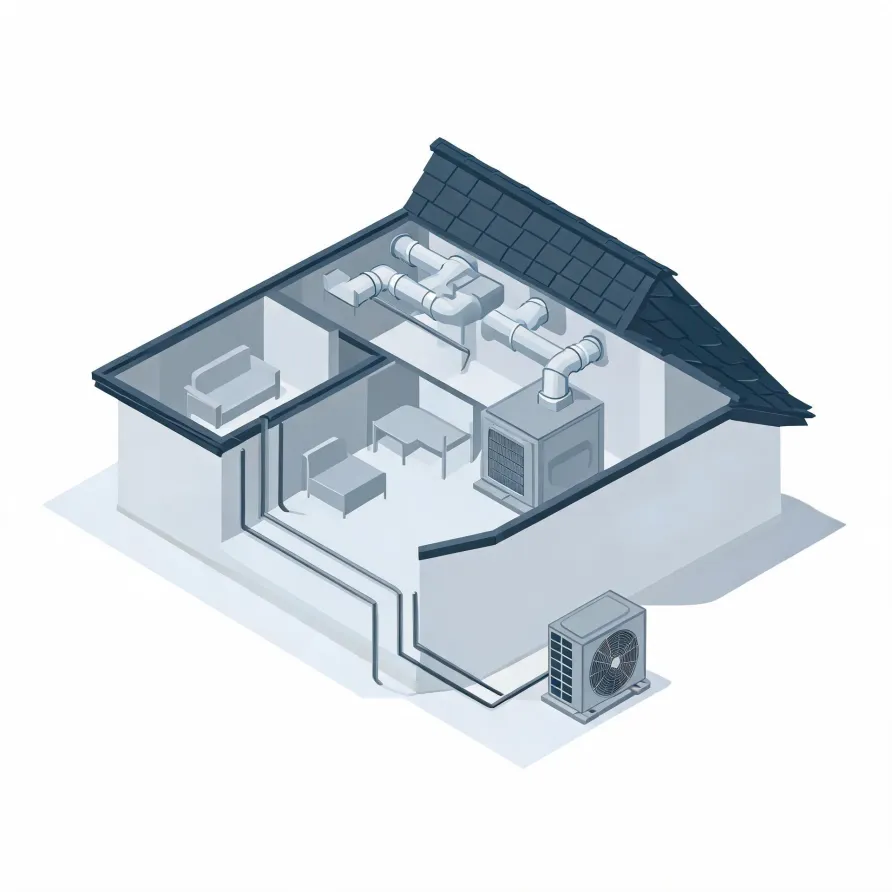
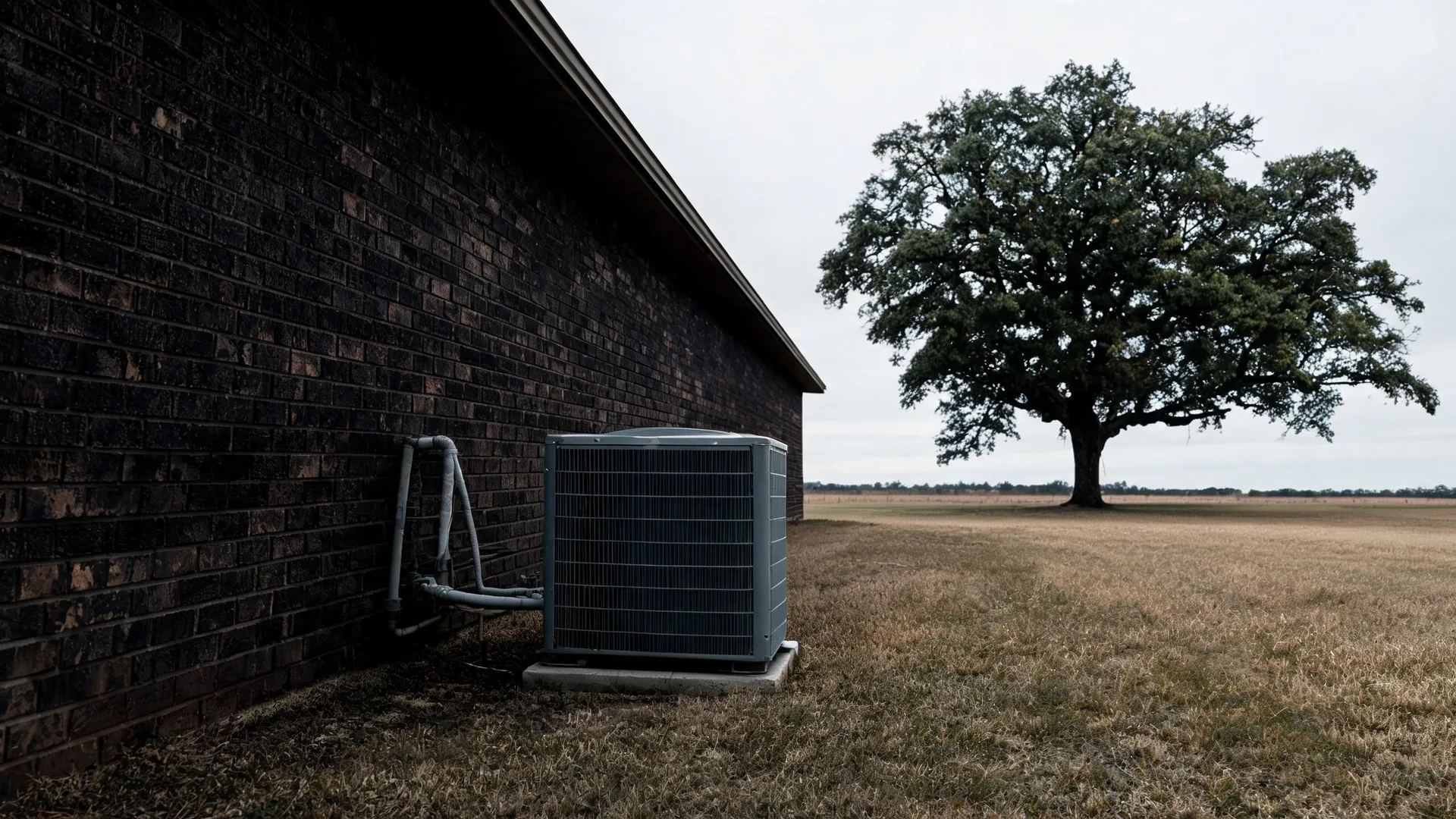
The outdoor condenser unit sits outside the house, usually on a concrete pad beside the foundation, and it is where the system sheds heat. A contractor working a repair call starts here, checking the compressor and the condenser coil, because a fault in either one stops the whole system. The air handler or furnace cabinet sits inside, often in a closet, utility room, or attic, and it moves cooled air through the house.
The evaporator coil lives inside that air handler cabinet, and it is where the refrigerant does its work on the air passing over it. A refrigerant line set runs between the two units, and the thermostat on the wall tells the whole system when to run. Both are common starting points when a contractor is tracing why a system is short-cycling, losing capacity, or not responding.
The drawing shows a typical layout, and a licensed contractor will determine which components and conditions apply to your specific home.
Get matched in Colorado CountyColorado County, Texas, by the numbers
32 severe weather events were recorded in Colorado County, Texas between 2015 and 2024.
NOAA National Centers for Environmental Information, Storm Events Database, bulk CSV export, events 2015-01-01 through 2024-12-31.Half the homes in Colorado County, Texas were built in 1983 or earlier (2020-2024 ACS 5-year).
U.S. Census Bureau, 2020-2024 American Community Survey 5-Year EstimatesColorado County, Texas holds 10,102 housing units (2020-2024 ACS 5-year).
U.S. Census Bureau, 2020-2024 American Community Survey 5-Year EstimatesOwners occupy 79.5% of the occupied homes in Colorado County, Texas (2020-2024 ACS 5-year).
U.S. Census Bureau, 2020-2024 American Community Survey 5-Year EstimatesCodes & Standards Governing Central AC Repair in Colorado County, Texas9 sourced rules and standards
What happens when a contractor comes out for HVAC repair
Split-system central air conditioners rated below 45,000 Btu/h manufactured on or after January 1, 2023 must meet a federal minimum of 13.4 SEER2.
Split-system central air conditioners rated at or above 45,000 Btu/h manufactured on or after January 1, 2023 must meet a federal minimum of 13.4 SEER2.
Split-system central air conditioners manufactured between January 1, 2015 and December 31, 2022 had to meet 13 SEER, the metric that preceded SEER2.
Single-package central air conditioners manufactured on or after January 1, 2023 must meet a federal minimum of 13.4 SEER2.
Space-constrained central air conditioners manufactured on or after January 1, 2023 must meet a federal minimum of 11.7 SEER2.
Federal efficiency standards for split-system central air conditioners and heat pumps are set on each certified combination of outdoor unit and indoor coil rather than on the outdoor unit alone.
Residential and light commercial air conditioning and heat pump systems assembled in the field, including mini-splits and unitary systems, may not be installed on or after January 1, 2025 using a refrigerant with a global warming potential above 700.
A field-assembled system whose specified components were all manufactured or imported before January 1, 2025 carries no installation compliance date under the refrigerant restrictions and may still be installed.
Licensing and Legal Requirements in Colorado County, Texas
In Texas a person may not engage in air conditioning and refrigeration contracting unless that person holds a license issued under the state air conditioning and refrigeration contractor law.
Severe Weather Events in Colorado County
Weather puts hours on HVAC equipment. Every surge, outage, or hard-running stretch through a Texas summer adds wear that shows up later as a repair call, and what Colorado County sees shapes what central AC systems here are asked to handle.
32 severe weather events, 2015–2024. Source: NOAA National Centers for Environmental Information, Storm Events Database.