Tell us about the job
Takes about a minute. No obligation.
A contractor quoting a central AC repair in Bee County works through the same list of suspects as anywhere else: age of the refrigerant lines, quality of the original install, how well the system has been maintained. 44 severe weather events were recorded in Bee County, Texas between 2015 and 2024. At that rate, severe weather lands here, but it does not define the operating life of equipment the way it does in harder-hit areas. A compressor that gave out this summer was carrying years of regular seasonal load, and that load, not any single storm, is where the diagnosis starts.
What a repair job costs and how long it takes is decided inside the unit, not on the driveway. Half the homes in Bee County, Texas were built in 1978 or earlier (2020-2024 ACS 5-year). Housing that old has rarely kept its original equipment, which means a contractor opening a system here finds a repair history written in spliced wiring, mismatched components, and parts that may belong to more than one service generation. Whether the replacement part a system takes is still manufactured is a real question, not a routine one. The answers come from what is physically in front of the technician once the panels are off.
The Parts of a Central AC a Contractor Checks First
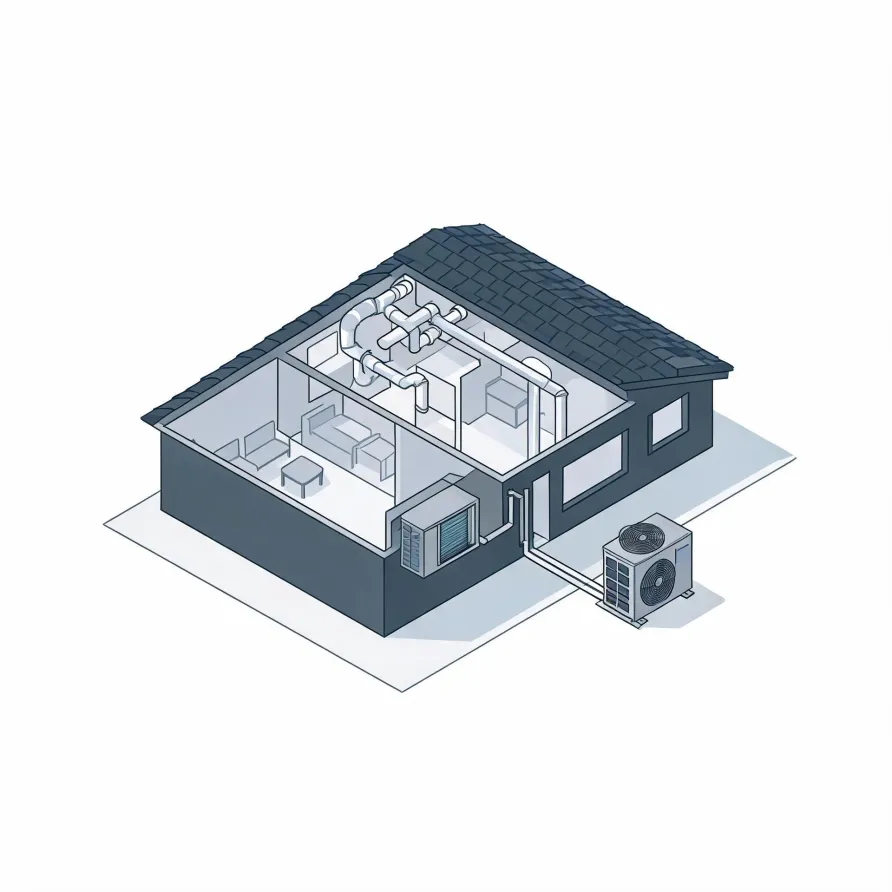
The outdoor condenser unit sits outside the house, usually on a concrete pad beside the foundation, and it carries the compressor and the condenser coil. These are the pieces a contractor reaches first when the system stops cooling. A failed compressor or a fouled condenser coil are common reasons a central AC runs but produces no relief.
Inside the house, the air handler or furnace cabinet holds the evaporator coil and the blower. The evaporator coil sits directly above the heat exchanger or in its own cabinet, and the blower pushes conditioned air into the supply plenum. A refrigerant leak, a frozen evaporator coil, or a blower motor that has lost speed can each stop the system in a different way, which is why a contractor works through both the indoor and outdoor sides before drawing a conclusion.
The drawing shows a representative layout, and a licensed contractor determines which components apply and what condition they are in for this particular house.
Get matched in Bee CountyBee County, by the numbers
44 severe weather events were recorded in Bee County, Texas between 2015 and 2024.
NOAA National Centers for Environmental Information, Storm Events Database, bulk CSV export, events 2015-01-01 through 2024-12-31.Half the homes in Bee County, Texas were built in 1978 or earlier (2020-2024 ACS 5-year).
U.S. Census Bureau, 2020-2024 American Community Survey 5-Year EstimatesBee County, Texas holds 10,650 housing units (2020-2024 ACS 5-year).
U.S. Census Bureau, 2020-2024 American Community Survey 5-Year EstimatesOwners occupy 70.8% of the occupied homes in Bee County, Texas (2020-2024 ACS 5-year).
U.S. Census Bureau, 2020-2024 American Community Survey 5-Year EstimatesCodes & Standards Governing Central AC Repair in Bee County, Texas9 sourced rules and standards
What HVAC Repair Looks Like in Bee County
Split-system central air conditioners rated below 45,000 Btu/h manufactured on or after January 1, 2023 must meet a federal minimum of 13.4 SEER2.
Split-system central air conditioners rated at or above 45,000 Btu/h manufactured on or after January 1, 2023 must meet a federal minimum of 13.4 SEER2.
Split-system central air conditioners manufactured between January 1, 2015 and December 31, 2022 had to meet 13 SEER, the metric that preceded SEER2.
Single-package central air conditioners manufactured on or after January 1, 2023 must meet a federal minimum of 13.4 SEER2.
Space-constrained central air conditioners manufactured on or after January 1, 2023 must meet a federal minimum of 11.7 SEER2.
Federal efficiency standards for split-system central air conditioners and heat pumps are set on each certified combination of outdoor unit and indoor coil rather than on the outdoor unit alone.
Residential and light commercial air conditioning and heat pump systems assembled in the field, including mini-splits and unitary systems, may not be installed on or after January 1, 2025 using a refrigerant with a global warming potential above 700.
A field-assembled system whose specified components were all manufactured or imported before January 1, 2025 carries no installation compliance date under the refrigerant restrictions and may still be installed.
What Bee County, Texas Requires for HVAC Repair Work
In Texas a person may not engage in air conditioning and refrigeration contracting unless that person holds a license issued under the state air conditioning and refrigeration contractor law.
Severe Weather Events in Bee County
Extreme weather puts real strain on AC equipment. The heavier the load the climate places on a system, the more a unit depends on being in solid mechanical condition.
44 severe weather events, 2015–2024. Source: NOAA National Centers for Environmental Information, Storm Events Database.